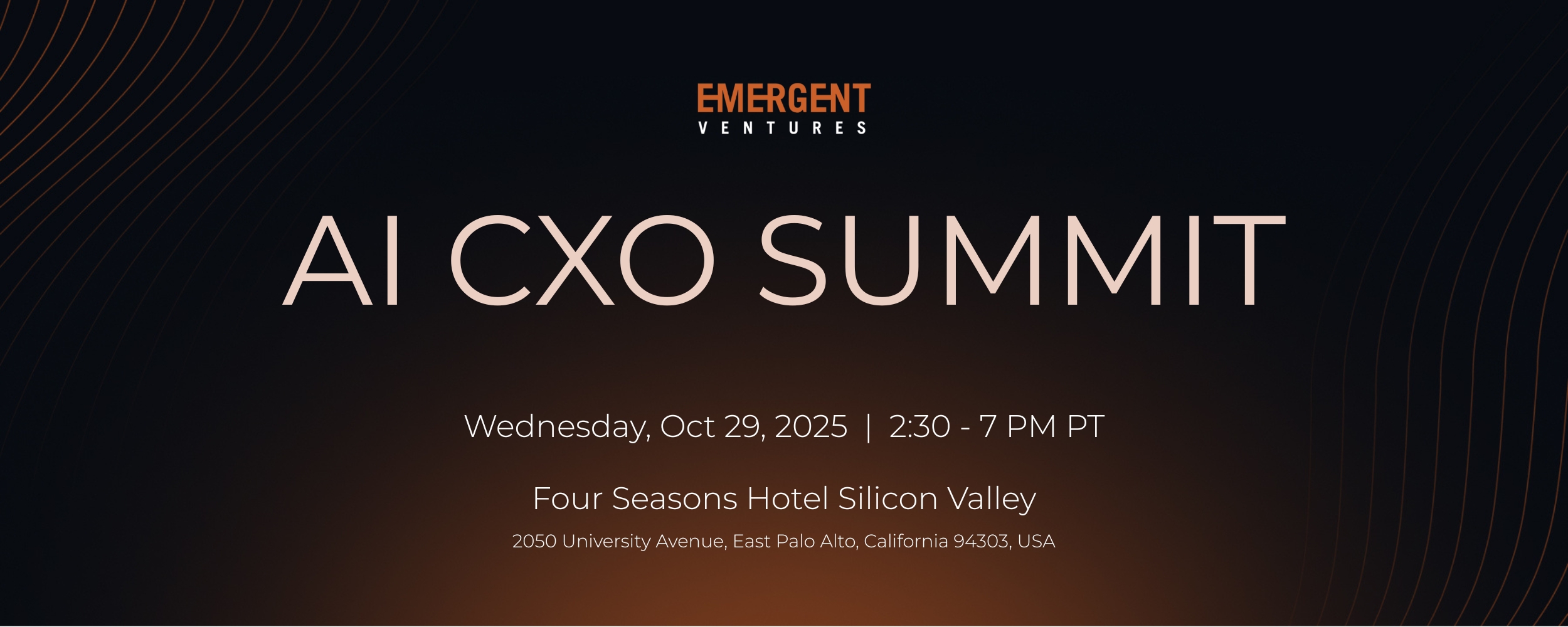
On October 29, 2025, Emergent convened the AI CXO Summit at the Four Seasons in Silicon Valley, bringing together over 200 senior leaders from global enterprises and fast-growing AI firms. The event was highly oversubscribed, reflecting the surge of interest from enterprise leaders actively deploying AI at scale. The gathering was a turning point for Enterprise AI, where executives, founders, and builders shared what’s working, what’s failing, and how to scale AI deployments meaningfully. Over a full afternoon and evening, participants engaged in keynotes, fireside chats, panels, and a networking reception, all aimed at accelerating Enterprise AI as it reaches its inflection point.
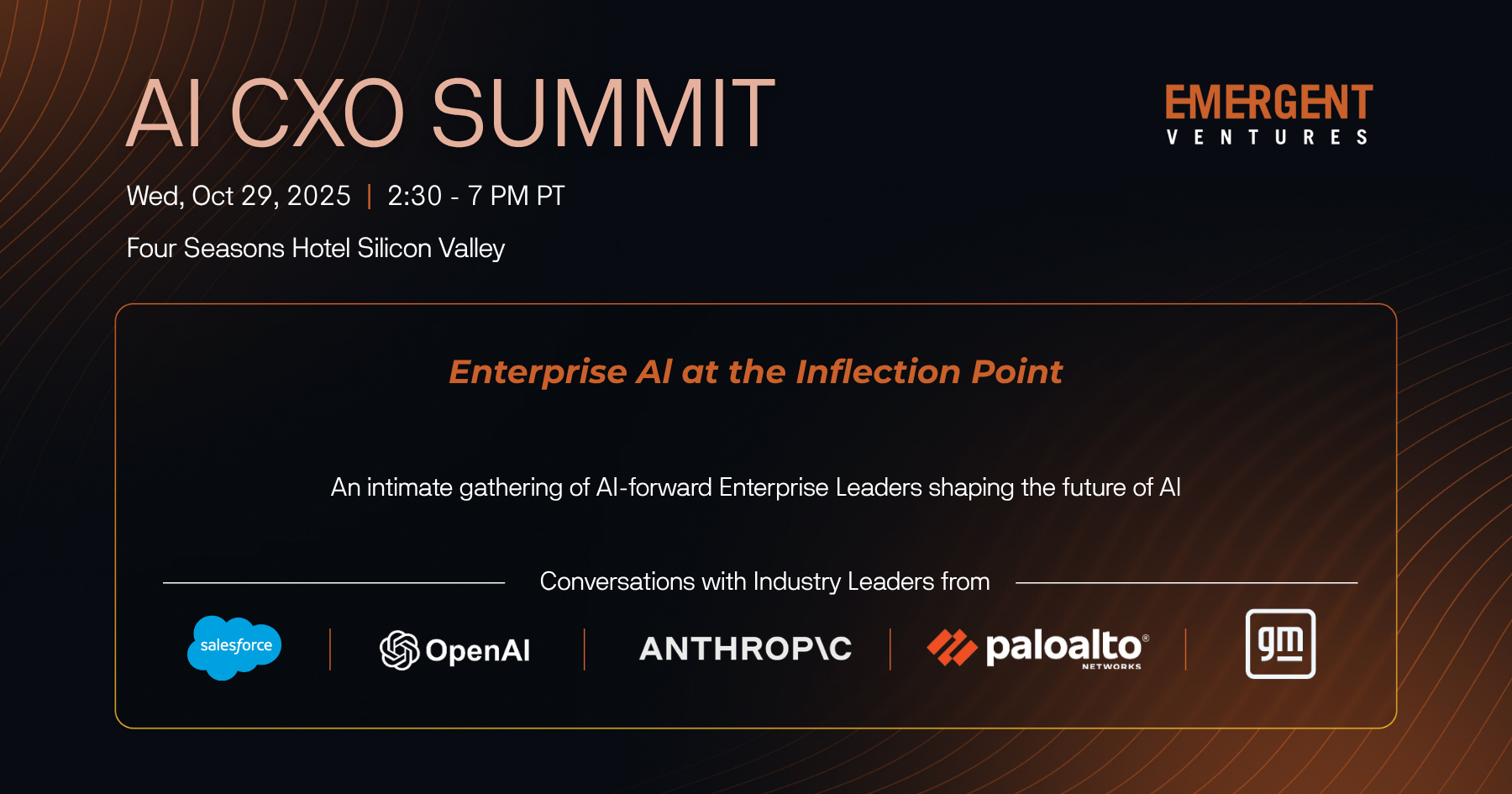
The Summit was designed to move beyond high-level AI narratives and into candid, practitioner-led discussions on deployment. Sessions spanned emerging trends, CXO adoption journeys, and trust in autonomous systems. The format emphasized signal over scale — a highly curated group of CXOs and founders engaging in honest dialogue, sharing hard-won lessons, and building relationships grounded in real execution.
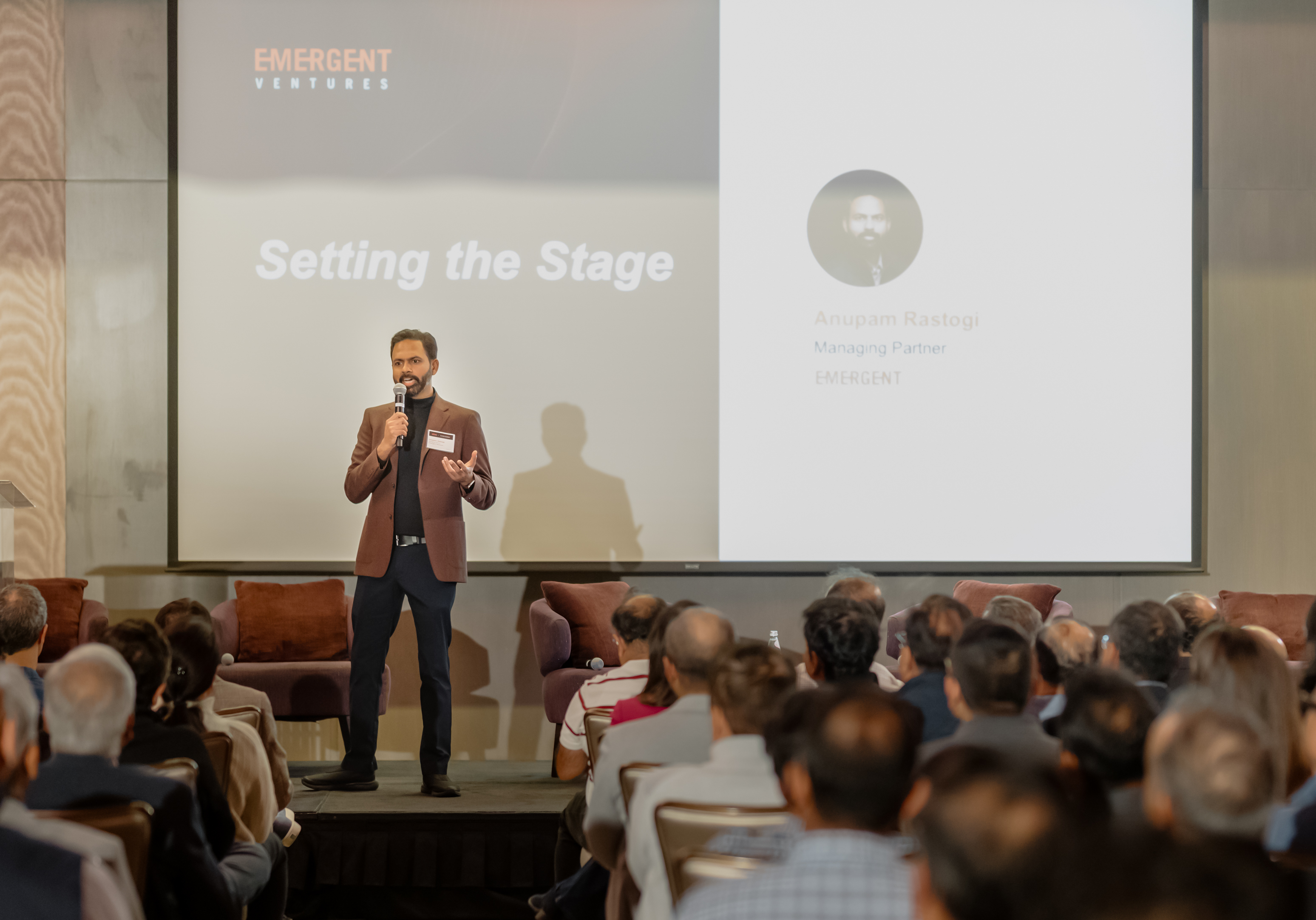
Setting the Stage
The kickoff session on Setting the Stage delivered by Anupam Rastogi, Managing Partner, Emergent Ventures, highlighted why 2025 - 2026 marks a pivotal moment for enterprise AI — its expansion beyond pilot projects and experimental use, and into scalable, real-world adoption.
Rather than treat AI as an isolated initiative, the Summit emphasized that AI is now reshaping operating models, workflows, user roles, governance standards, and core systems. Anupam laid out the Summit’s three cross-cutting themes, which became the intellectual spine of the following discussions:
- Strategic vs Bottom-Up Adoption
Enterprise AI today unfolds along two paths: strategic programs led by CXOs and business owners, and PLG-style adoption driven organically by teams or individuals. Bottom-up tools have moved fastest in this wave, but strategic adoption will become essential as enterprises re-architect core workflows and systems around AI. - Problem-First vs AI-First
The most effective deployments start with a clearly defined business problem and measurable outcomes. AI-first experimentation has a role in discovery, but adoption scales only when initiatives are anchored in ROI, operational ownership, and tight alignment between business and AI teams. - General vs Purpose-Built Solutions
While horizontal platforms and foundation models provide powerful primitives, enterprise use cases demand depth — domain context, orchestration, human-in-the-loop systems, and robust governance. Purpose-built solutions increasingly outperform by solving complex, high-value workflows end-to-end
Together, these themes set the tone: enterprise AI is no longer about experimentation — it is about disciplined execution at scale.
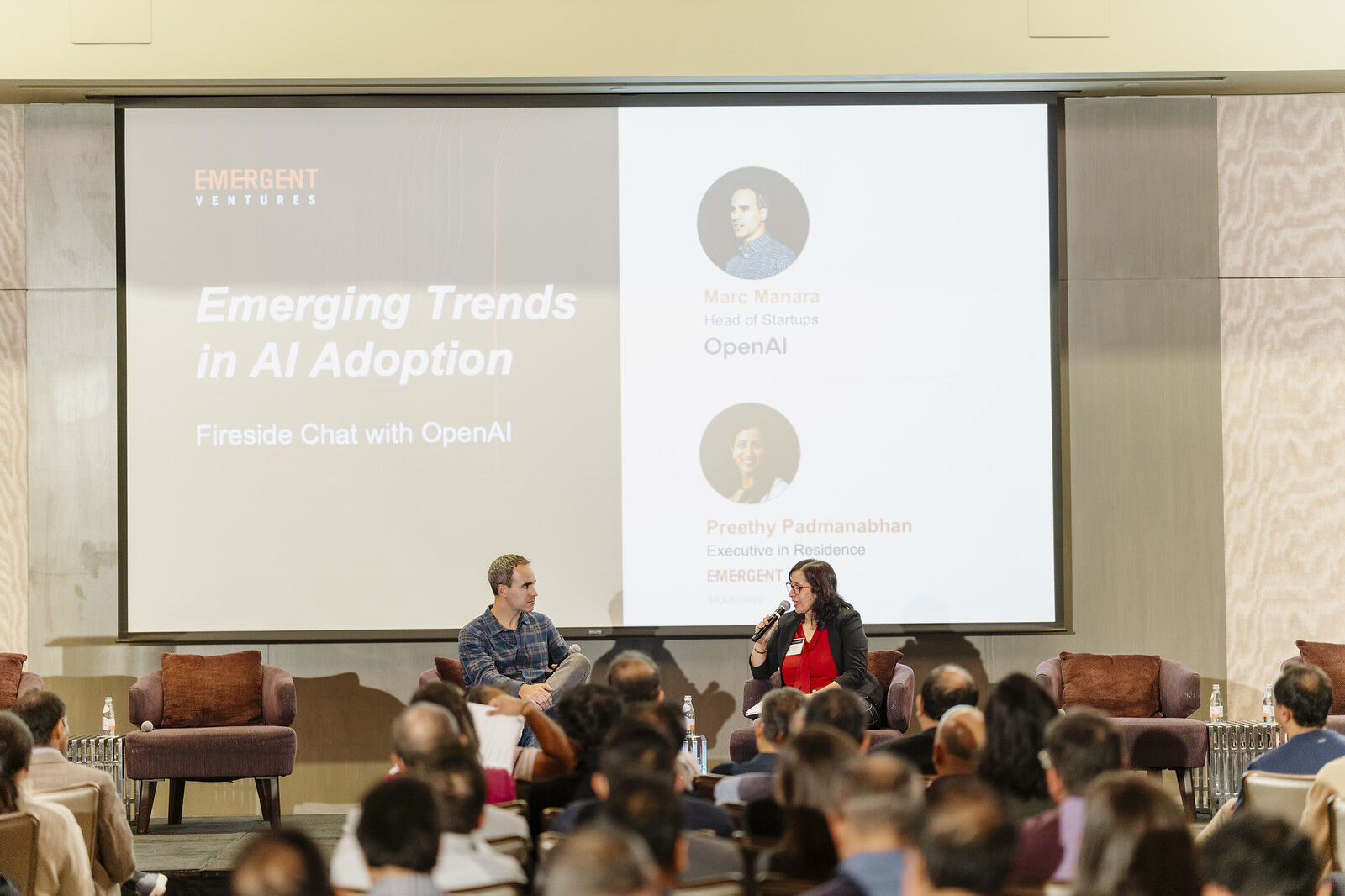
Emerging Trends in Enterprise AI – with Marc Manara, Head of Startups, OpenAI
The fireside chat session with Marc Manara, Head of Startups, OpenAI highlighted how enterprise AI is entering a second-wave transition: from experimentation to scaled execution. Bottom-up PLG models have moved fastest, as individual teams adopt GenAI products and lightweight tools offer fast time to value and minimal procurement friction — a classic PLG-driven early adoption curve. However enterprise-wide value will ultimately require top-down strategic approaches.
The session also underscored the scale of the opportunity: the enterprise AI market could reach $5T, potentially surpassing SaaS and cloud in economic impact. That projection reflects not just workforce automation, but new forms of orchestration, agentic workflows, business-model redesign, and systems transformation. In the language of the Summit themes, durable value will be created when strategic adoption meets domain depth, not when GenAI is treated merely as a productivity tool.
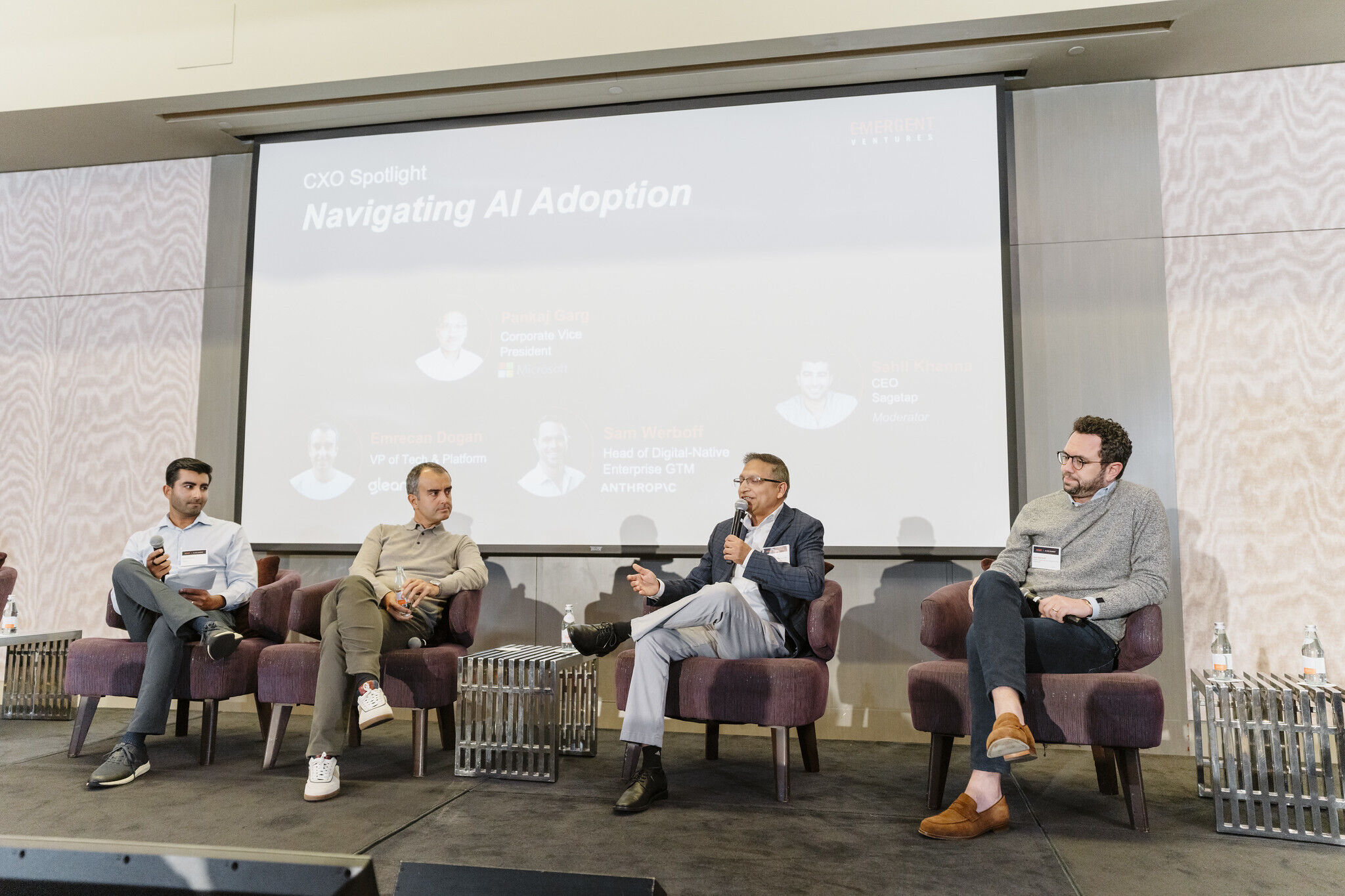
CXO Spotlight: Navigating Enterprise AI Adoption
In the “CXO Spotlight: Navigating AI Adoption” session, senior leaders Pankaj Garg, Corporate Vice President, Microsoft; Sam Werboff, Head of Digital Native Enterprise GTM, Anthropic; Emrecan Dogan, VP of Tech & Platform, Glean; Sahil Khanna, CEO, Sagetap, examined how enterprises can move beyond pilots — confronting the messy reality of legacy data, internal infrastructure limitations, and culture hurdles that often block scalable AI.
Speakers stressed that success isn’t just about picking the “shiniest AI tool,” but about integrating AI in ways that deliver measurable business outcomes. As one leader put it, the challenge is rethinking workflows, aligning data, and reshaping the internal operating model so that AI becomes part of the organizational fabric — not an add-on.
Importantly, the discussion acknowledged the human and organizational dimension: adoption requires not only technology but also vision, readiness to change processes, and a culture willing to embrace AI-driven transformation This conversation illustrated the Problem-First vs AI-First theme in vivid color. AI becomes a means to an end, not the focal point.
Trust, Human-in-the-Loop, and Purpose-Built Intelligence
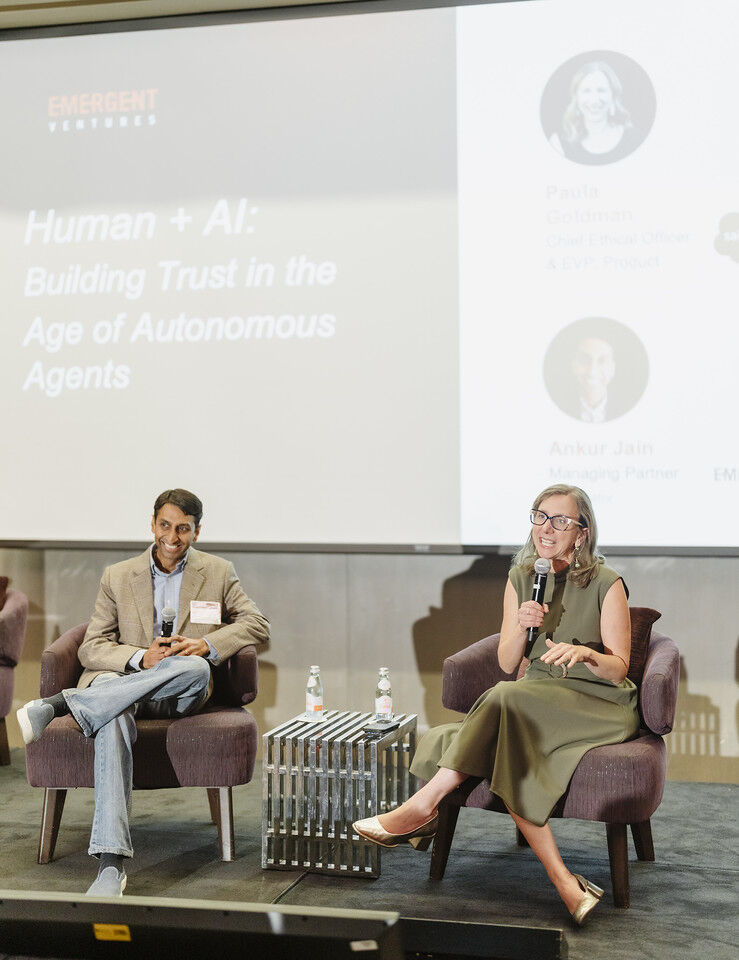
A central theme resonating throughout the Summit was trust — how to deploy “agentic AI” responsibly and sustainably. Paula Goldman, Chief Ethical Officer of Salesforce argues that as AI agents gain more autonomy, building justifiable trust becomes paramount. Rather than thinking of AI purely as a tool, we need to think of it as a collaborator — one that requires clear guardrails, human oversight, and thoughtful design.
Salesforce’s approach centers around what Goldman calls “trust patterns,” a set of design and governance principles to ensure AI acts ethically, transparently, and reliably. These include “mindful friction” (introducing human-in-the-loop checkpoints), awareness of when AI is on autopilot, explainability mechanisms, bias and toxicity safeguards, and mechanisms to reduce hallucinations or incorrect outputs. (Salesforce)
Paula further emphasized that adoption isn’t just about automation — it’s about empowering people. AI literacy matters. Humans need to know how to use AI intelligently, recognize when it errs, and correct course. As autonomy increases, human judgment, oversight, and ethical frameworks will remain central. At the Summit, this lens on trust — as a foundation for sustainable, enterprise-grade AI — resonated strongly, signaling that ethics and practical deployment are no longer separate tracks but deeply intertwined.
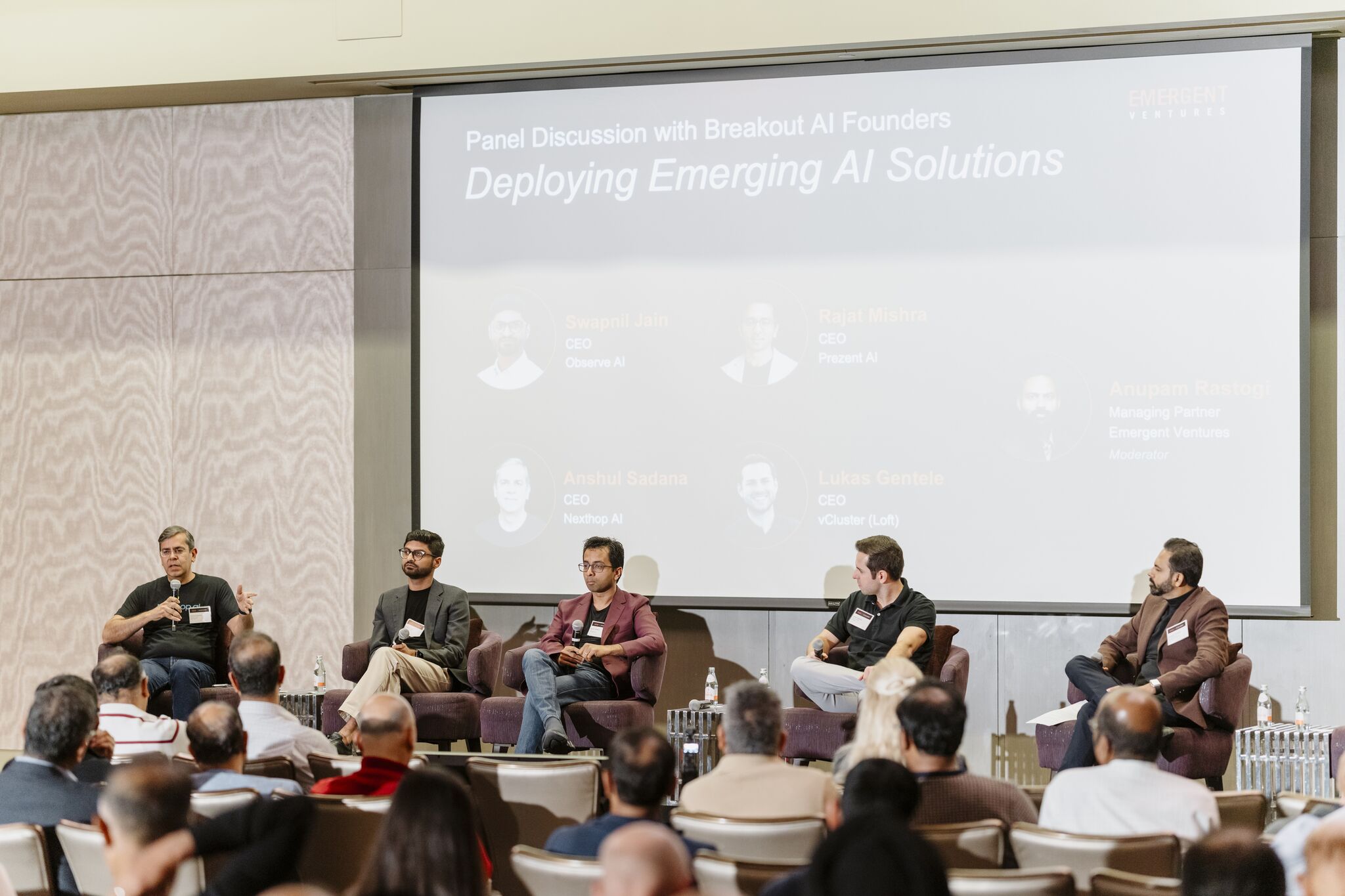
Deploying Emerging AI Solutions – Founder Insights
Another standout moment was the founders’ panel titled “Deploying Emerging AI Solutions,” featuring industry builders such as Swapnil Jain,CEO Observe.AI, Rajat Mishra, CEO Prezent, Anshul Sadana, CEO Nexthop AI and Lukas Gentele, CEO vCluster
This session gave a front-line view of what it takes to go from alpha to enterprise deployment. The conversation turned pragmatic: how to build AI products that are not just technologically impressive, but enterprise-ready. These founders emphasized patterns such as: focusing first on concrete business problems, delivering clear ROI and value, building with enterprise-grade data and security practices, and ensuring smooth integration with existing workflows.
Another recurring theme: the difference between customizing AI solutions for a single enterprise vs. building scalable platforms that can be adopted across many organizations. Founders noted that flexibility, modularity, and robustness matter — AI solutions often fail not because of poor models, but because enterprise infrastructure, compliance or data constraints were underestimated.
Perhaps most compelling was the acknowledgment that real enterprise AI isn’t about flashy demos; it’s about slow, steady work: data hygiene, change management, user training — the hard, unglamorous parts that make AI reliable, maintainable, and trustworthy over time.Durable value comes from aligning incentives, solving deeply, proving ROI, and designing for the realities of production.
Enterprise AI Showcase
The Summit also featured the Emergent Enterprise AI Showcase — a curated set of eight portfolio companies with production deployments across leading enterprises. These were real systems in-market, solving high-value workflows with measurable impact. These systems spanned a wide range of use cases: customer operations and contact centers, data and AI infrastructure, revenue workflows, cybersecurity, and verticalized enterprise functions — reflecting how AI is being applied across industries from financial services and healthcare to software and telecom. The showcase grounded the day’s discussions in execution, illustrating what enterprise AI looks like when it moves beyond pilots into scaled deployment.
Emergent AI CXO Network
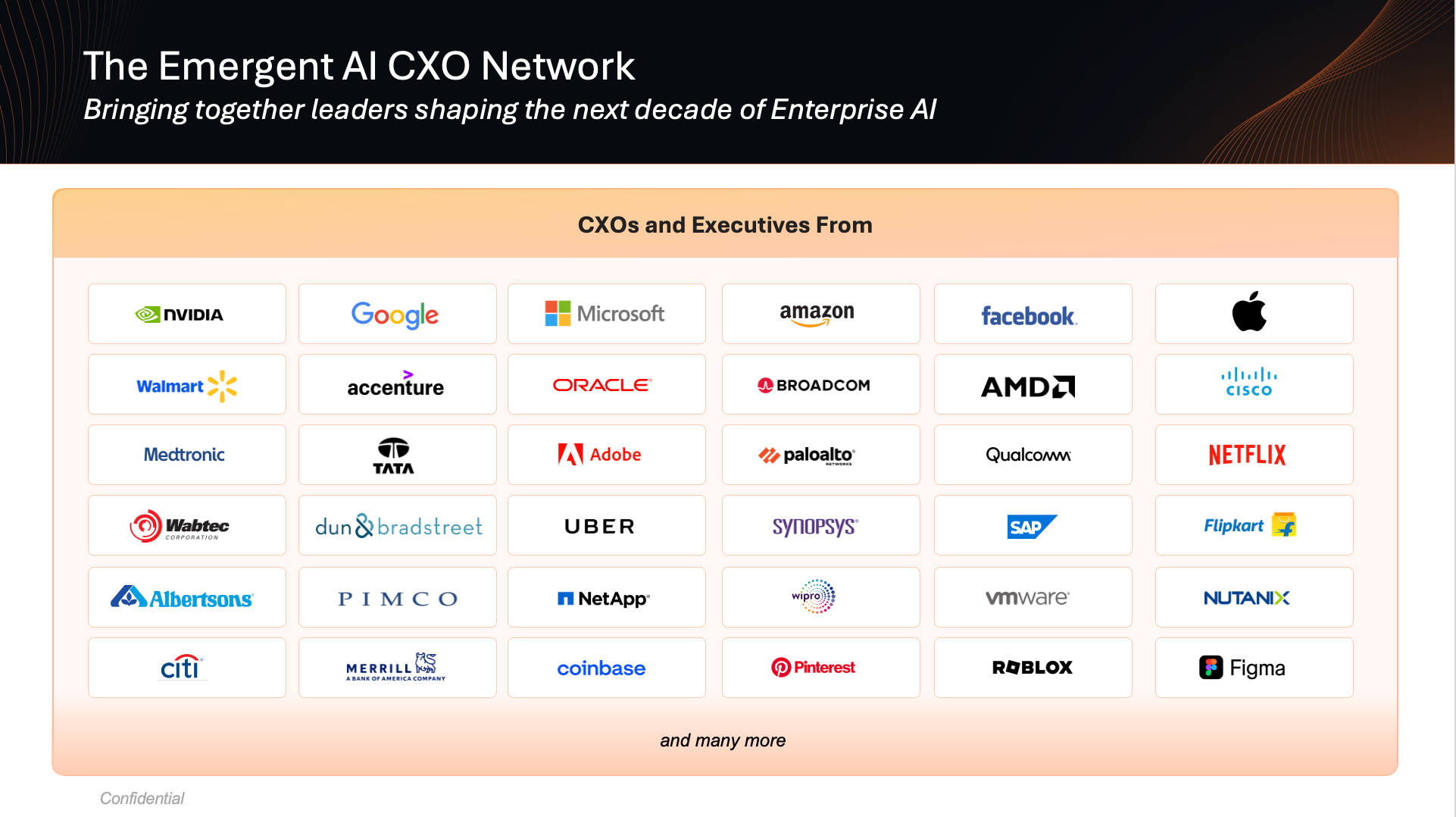
In the closing remarks, we introduced the expanded Emergent AI CXO Network — a curated group of senior operators shaping how AI is deployed inside large enterprises. For CXOs, it’s a peer forum for candid exchange on what’s actually working in production. For founders, it creates a direct line into real-world feedback and the realities of enterprise adoption.
Candid Conversations, Real Connections
The evening concluded with a networking reception that carried the same tone as the Summit — high-signal, low-noise. CXOs, founders, and AI leaders gathered in a relaxed setting, exchanging ideas, pressure-testing perspectives, and sharing what’s actually working in production. Conversations flowed easily — from reconnecting with long-time peers to forming new relationships rooted in shared challenges. It was a reminder that in enterprise AI, real progress often happens in these candid, off-stage moments.
.jpg)
Summit Takeaways and Looking Ahead
Across sessions, a clear pattern emerged: enterprise AI is entering its execution phase.
Three realities will define the next decade:
- Bottom-up and top-down adoption must converge. Speed comes from the former; transformation from the latter.
- Problem-first design drives adoption. AI initiatives succeed when tied to real workflows, measurable ROI, and clear ownership.
- Depth wins. Purpose-built systems with domain context, orchestration, and trust mechanisms will outperform horizontal tooling alone.
Just as importantly, the Summit itself reflected how this next phase will unfold. Numerous high-quality connections emerged across CXOs, founders, and operators. Portfolio founders walked away with direct insights from practitioners on what it takes to move from pilot to production. And many enterprise leaders got a firsthand view of the cutting edge in AI — learning not just from vendors, but from peers navigating similar challenges across functions.
These conversations are just getting started. They will continue through the Emergent AI CXO Network, with a series of curated gatherings and forums ahead.
The shift underway is fundamental. The next wave of value will not come from model innovation alone, but from re-architecting how enterprises operate — with AI embedded at the core.
.jpg)
.jpg)
.jpg)
More from Emergent



We help founders get to the *next level
We’re hands-on partners to ambitious Enterprise AI founders. We invest early and help achieve product-market fit, build go-to-market, and scale into breakout growth.

